Tesla Roadster. Why Does Everything Have to Make Commercial Sense?
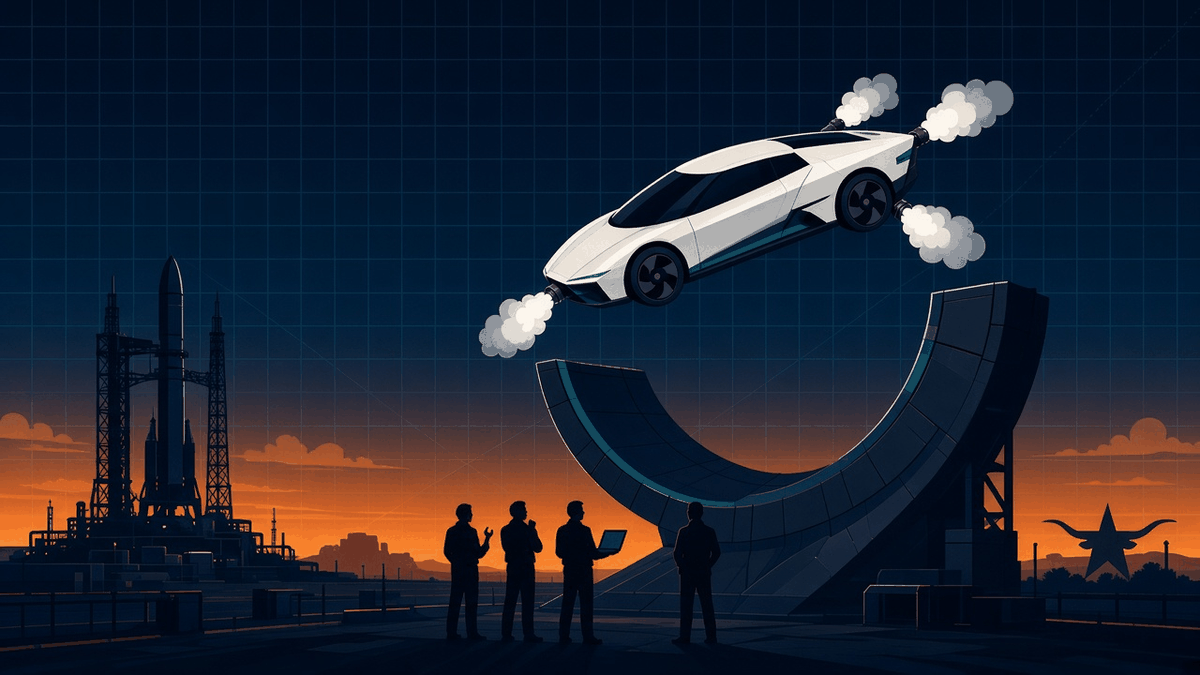
Tesla finally unveiled its new Roadster on October 15, and the reactions have been quite revealing. We watched a car accelerate from 0 to 60 mph in 0.81 seconds, drive upside down, launch itself into the air, rotate and land using compressed-gas thrusters developed with SpaceX. It was an extraordinary engineering demonstration. But much of the discussion immediately moved to whether anyone could actually buy it, whether it would ever be road legal, and how many years Tesla had wasted developing something with such limited commercial potential.
Some criticism is perfectly justified. Tesla announced the second-generation Roadster in 2017, originally promised production in 2020, and is now talking about 2028. The flying Rocket version demonstrated on Thursday is not a conventional road car, and Tesla has not established a credible path to making it widely available. Customers have been waiting for years, some having paid substantial reservation deposits. Still, I find something quite depressing about the assumption that engineering work without an immediately saleable product is necessarily wasted work.
The reactions tell an interesting story
On Reddit, even the Tesla enthusiast communities are divided. People praised the technical achievement and congratulated the engineering team, while in the same discussions others questioned whether the car would ever reach production, how safe the technology is and what practical use it could have. On Hacker News and Ars Technica, the discussion was considerably more sceptical, with contributors questioning whether the demonstration amounted to anything beyond an expensive publicity stunt.
The press followed a similar pattern. MarketWatch quoted an analyst describing the Roadster as an engineering exercise with little commercial value. The Atlantic questioned the entire flying-car concept, while a Washington Post opinion piece defended the value of technically ambitious projects without an obvious practical application.
What interests me is how quickly the discussion becomes a financial assessment, about how many cars Tesla will sell, what they will cost and what the return on the investment will be. These are legitimate questions for Tesla's management and shareholders. But they are not the only questions worth asking.
Engineering is also about doing things because you can
I came across a comment on a technology forum that captured something I think many companies have forgotten. The author argued that when you have an organisation made predominantly of engineers, with fewer people focused on sales, marketing and management, you occasionally end up doing crazy things simply because you can, and that this is not necessarily a problem.
Think about the engineers who worked on the Roadster. They had to integrate aerospace propulsion technology into an automotive platform, manage thrust, stability and vehicle dynamics during manoeuvres no conventional car was designed to perform, and coordinate control systems across several engineering disciplines. Whether the final product sells 10,000 units, 100 units or none at all, those people have worked on something they will probably remember for the rest of their careers. I suspect many of them would consider the opportunity itself a significant professional reward.
This matters because highly skilled engineers are not motivated exclusively by salaries, bonuses and promotions. They also want interesting problems, technical freedom, competent colleagues and the satisfaction of building something that has never been built before. A company can offer excellent compensation and still become an intellectually boring place to work, and once that happens, retaining exceptional engineers becomes considerably harder.
The problem with optimising everything for business value
Over the years, many technology companies have become extremely sophisticated at measuring engineering productivity, prioritising roadmaps and calculating the expected return of every initiative. There are good reasons for this. Engineering capacity is expensive and limited, and organisations need to make decisions about where to invest it. But the process can become excessive.
When every project needs a business case, experiments need a measurable outcome and engineering initiatives must justify themselves against quarterly objectives, the organisation gradually removes the space for work whose value is not yet understood. Engineers become exceptionally good at delivering incremental improvements to existing products, while opportunities to explore technically difficult or unconventional ideas become increasingly rare.
The consequences are not always immediately visible. Products continue to ship, roadmaps remain predictable and financial metrics might even improve. But something changes in the engineering culture. People stop proposing things they cannot justify in advance, technical curiosity becomes a personal activity rather than something the company encourages, and some of the most capable engineers eventually look elsewhere.
The Roadster is not just a toy, even if it never becomes a product
There is another aspect worth considering. Developing an experimental vehicle like this requires solving problems that do not necessarily disappear when the project ends. The Roadster combines compressed-gas propulsion, active aerodynamic systems, electric powertrains and real-time vehicle control. These technologies are not all new, and Tesla has not invented the underlying principles. Fan-assisted downforce, for example, has a long history in motorsport, from the Chaparral 2J in Can-Am in 1970 to the Brabham BT46B in Formula 1 in 1978. What is unusual is their integration into a single vehicle capable of the manoeuvres demonstrated.
That work creates engineering knowledge. It exposes integration problems, develops control techniques and forces teams to test assumptions outside normal operating conditions. Some of what the engineers learned may eventually become useful in other Tesla or SpaceX projects, and some probably won't. We cannot know the eventual value of that work from a product demonstration, and claiming that the Roadster will necessarily produce important technological breakthroughs would be just as speculative as calling the entire project a waste.
Technical experimentation has never guaranteed useful results, and that uncertainty is part of what makes it experimentation. There is also a difference between demonstrating a technology and proving that it can become a reliable, maintainable, safe and economically viable product. Tesla has demonstrated the former. It has not yet demonstrated the latter.
Of course, someone still has to pay for it
None of this means that companies should allow engineers to spend unlimited resources on whatever interests them. Tesla has legitimate commercial problems to solve. Its mainstream automotive business faces competition, the company is investing heavily in autonomy and robotics, and the Roadster has already missed years of promised deadlines. If the project has consumed engineering resources that would have been better used elsewhere, management should be held accountable. And customers who reserved a car in 2017 have every reason to be frustrated.
But we also need to distinguish between a poorly managed product commitment and the value of the engineering work itself. Tesla might have made questionable decisions about the Roadster's commercial development while simultaneously giving its engineers an extraordinary technical opportunity, and both things can be true. The actual engineering cost, the opportunity cost and the long-term technical benefits are not public enough to make a definitive assessment. What we can observe is the result, and the fact that Tesla was willing to pursue something with little immediate commercial justification.
We need more room for crazy engineering
What bothers me about the reaction to the Roadster is not the criticism of Tesla or Musk. There is plenty to criticise, particularly around delivery commitments and the difference between demonstrations and finished products. It is the increasingly common expectation that engineering should always produce something commercially useful, preferably within a predictable timeframe.
I have seen how much energy engineers put into projects when they are genuinely excited about what they are building, and how different that is from simply executing another item on a roadmap. An organisation cannot operate entirely on passion projects, but it probably shouldn't operate without them either. There is a reason why companies historically created research laboratories, experimental divisions and engineering programmes that were not expected to produce immediate revenue. Some generated valuable technology, others produced little beyond experience and knowledge, and their value was not always obvious at the beginning.
The Roadster might turn out to be an expensive distraction, or it might contribute useful technology to future projects. It could also remain a spectacular demonstration that a small group of engineers will remember for the rest of their lives. I don't think we have enough evidence to decide which one it is. But I find it difficult to look at what those engineers built and conclude that their time was wasted simply because the result cannot be sold in a showroom. Sometimes engineers should be allowed to build something crazy, not because it will necessarily change the world, but because working on difficult, ambitious and occasionally impractical things is also part of what makes engineering worth doing.